
Chile Expands Ocean Protections Around Remote Juan Fernandez and Desventuradas Islands
Designation will benefit fisheries, local community, and region’s dazzling biodiversity

Overview
In the southeastern Pacific Ocean, two remote island chains off the coast of Chile share a remarkable story that began with their discovery in 1574. The archipelagos of Juan Fernández and the Desventuradas Islands, separated by hundreds of miles of open ocean, together harbor what scientists consider to be the highest concentration of endemic marine species, that is, species found nowhere else on Earth.1
In fact, more than 60% of these island chains’ coastal fish species are endemic.2
Recognizing the importance of this unique ecosystem, the Chilean government established two vast fully protected, no‑take marine parks. One in 2016 called the Nazca-Desventuradas Marine Park—the largest fully protected area in Chile at the time, spanning about 116,000 square miles (300,000 square kilometers)—and then another in 2018 called the Juan Fernández Marine Park, which added approximately 101,200 square miles (262,000 square kilometers) of full protection. Together, these two marine protected areas (MPAs) protect an area larger than France. Separately, the government also created a 15,000-square-mile (24,000-square-kilometer) multi-use zone that allows limited artisanal fishing and recreational use around the Juan Fernández archipelago.
The protected areas were established with strong local support, and a key development was the legal recognition of the community as co-managers of the MPAs. Since June 2024, the marine parks’ management council has included six representatives from government and seven from the Organización Comunitaria Funcional Mar de Juan Fernández (OCF Mar de Juan Fernández), the community-led organization that jointly manages the MPAs. The organization collaborates with local and international groups—including Pew Bertarelli Ocean Legacy, Island Conservation, Blue Marine Foundation, and Patagonia Azul—to protect marine ecosystems and support sustainable livelihoods.
In 2025, OCF Mar De Juan Fernández developed a proposal to expand the marine protections around the Juan Fernández and Desventuradas Islands. Members of the organization went door to door in Robinson Crusoe, the population center of the Juan Fernández Islands, to consult with locals. Every household received information about the proposal by the end of August, and 99% of residents expressed their support.3
With that overwhelming support, OCF Mar de Juan Fernández officially asked the government in September to expand the fully protected areas to further safeguard the waters around the archipelagos from growing threats such as harmful industrial fishing, marine pollution, and potential seabed mining activities, and to build resilience against climate change and ocean acidification.
Following this request, Chile’s Ministry of Environment launched a month-long consultation process in February to solicit public feedback that was then passed along to the Council of Ministers for Sustainability and Climate Change, which ultimately recommended the president approve the expansion.4
On March 10, President Gabriel Boric signed a decree to create two new fully protected areas adjacent to the existing parks. The designated waters span across a total of 347,209 square miles (899,268 square kilometers) between the two ecoregions—an area roughly 20% larger than Chile’s land territory. Once these added safeguards are implemented, Chile will protect more than 50% of the country’s exclusive economic zone, representing a significant contribution to the global goal known as “30 by 30”—which was agreed to in 2022 by the Convention on Biological Diversity—to protect at least 30% of the global ocean by 2030.
Science has shown that limiting fishing and other harmful activities in large areas of the ocean can help protect marine life and its habitats. Protecting key areas, such as spawning and nursery grounds, is especially effective at rebuilding fish populations and supporting healthy fisheries immediately around the protected areas and beyond.5
Chile’s action to fully protect the remainder of the exclusive economic zones around the Desventuradas and the Juan Fernández Islands will better safeguard the ecoregions’ abundant and endemic marine biodiversity and highly vulnerable ecosystems.
Isolated islands shaped by powerful ocean forces
The Juan Fernández archipelago, located about 415 miles (670 kilometers) west of central Chile’s coast, is made up of three volcanic islands: Robinson Crusoe (formerly Más a Tierra), Santa Clara, and Alejandro Selkirk (formerly Más Afuera). Fewer than 1,000 people live here, relying mainly on tourism and a lobster fishery for their livelihoods. Approximately 530 miles (850 kilometers) north of the archipelago are the Desventuradas Islands, which consist of San Félix and San Ambrosio. While there are no civilian inhabitants on these islands, San Félix is home to a Chilean navy detachment and the small Isla San Félix Airport.
Upwellings from the cold-water Humboldt current, which flows north from Antarctica along South America’s coast, force deep ocean nutrients to the surface, contributing to high levels of marine biodiversity.
Studies have shown the Juan Fernández archipelago creates a natural “island mass effect,” where ocean currents and winds further increase nutrients near the surface, which attracts an array of marine life to the area.6 While nearby open‑ocean waters can also be productive at times, the mass effect consistently amplifies this by generating chlorophyll‑rich wakes and eddies.7
Exceptional biodiversity—and what it takes to protect it
Scientific expeditions in 2014 found that 87.5% of the fish surrounding Robinson Crusoe Island and 72% surrounding San Ambrosio Island are endemic to the region—the highest level of endemism recorded in any marine ecosystem on the planet.8 When considering the wider Juan Fernández and Desventuradas region, approximately 62% of all reef fish species here exist nowhere else on Earth.9
Another expedition near the Juan Fernández archipelago in 2015 revealed the significant impacts trawling had on marine life, including evidence of near depletion of some fish species, such as alfonsino and orange roughy fish.10 Trawlers had not only depleted the target species but also destroyed ancient, slow-growing corals and decimated populations of top predators such as sharks and cod. In 2015, Chile became the first country to ban bottom trawling around all its seamounts—underwater mountains that rise hundreds to thousands of feet from the seafloor—but marine species are still recovering from its impacts.
The expedition also found promising signs of resilience within the protected areas. Small corals, like those thriving in the Desventuradas Islands, were beginning to recolonize, potentially serving as a seedbed for recovery. The discovery of dwarf lobsters and Juan Fernández splendid perch also provided evidence of the biological corridors connecting these distant archipelagos, suggesting that recovery, while slow, remained possible.

New protections connect migratory corridors for vulnerable species
Across the world, marine species travel long distances along migratory pathways to feed and breed. To help marine life travel safely, marine scientists recommend the creation of interconnected regional networks of large and effective MPAs.11
The expansion of the Chilean MPAs will protect a significant portion of the migratory corridor between Juan Fernández and the Desventuradas Islands, which protected marine mammals such as blue whales, humpback whales, southern right whales, and spotted dolphins use.12 The larger protected areas will also benefit many fish species, green sea turtles, and sharks, such as shortfin makos and blue sharks.13
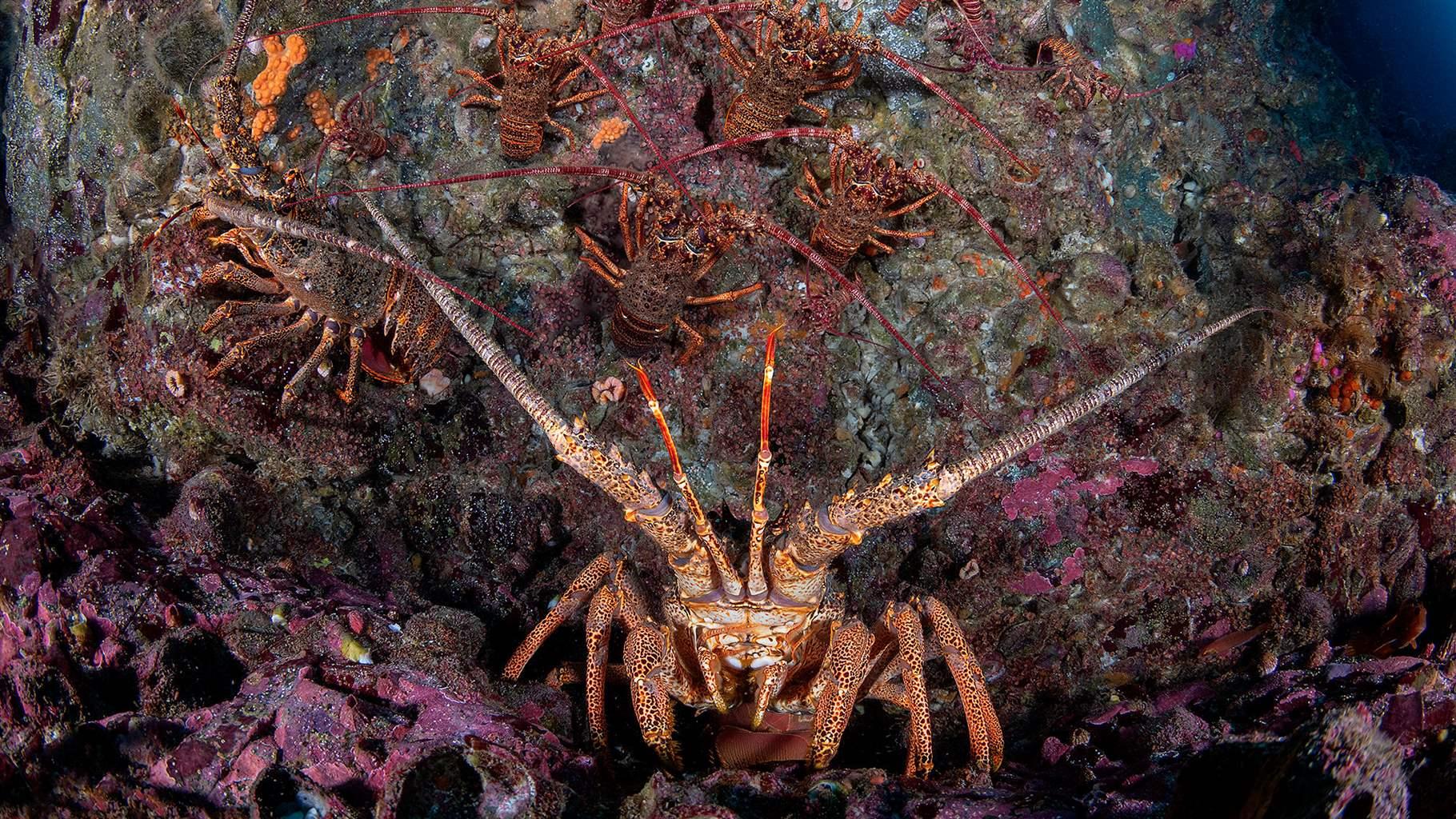
The Juan Fernández archipelago and Desventuradas Islands share a variety of marine flora and fauna that swim between the two areas, including endemic species such as the Juan Fernández lobster and Juan Fernández fur seal.
The connection between the archipelagos is also reflected above the waves with seabirds: Half of the species that nest in the Juan Fernández archipelago also call the Desventuradas Islands home.14 These pelagic wanderers rely on both archipelagos for feeding and migration, creating an aerial highway across the ocean, underscoring the importance of protecting connected marine habitats at scale.
Another key feature that supports biodiversity in this region are seamounts, which provide habitat for a wide variety of life, including corals, mollusks, crustaceans, fish, and marine mammals. They also provide refuge for migratory species, such as tuna, sea turtles, sharks, and whales. The Nazca-Desventuradas and Juan Fernández ecoregion contains 36 seamounts, the largest concentration in Chilean waters.15
And in a move that promises even further protections in the region, the community is collaborating on a proposal to safeguard nearby seamounts in international waters, along the Nazca Ridge, something that is now possible with the new U.N. high seas treaty in force.16
Marine protections support artisanal fishing practices
Drawing on their ancestral knowledge, the people of Juan Fernández have led the effort to protect the region’s biologically rich waters that have been an integral part of the community’s history, culture, and livelihoods.
For more than 130 years, the artisanal fishers of Juan Fernández have used sustainable gear and have adhered to self-imposed regulations to ensure the conservation of the lobster fishery. Only licensed residents may harvest the Juan Fernández rock lobster—the main species caught here—and they do so with traditional wooden traps.
This fishery makes up about 46% of the Juan Fernández archipelago’s economy, but it is also a cultural practice that connects people to the islands’ heritage and the sea.17
In fact, when considering the creation of the MPAs, the Juan Fernández community prioritized the historical rights of artisanal fishers. The Chilean government honored this by including in the MPAs a multiple-use area around the Juan Fernández Islands where artisanal fishing can continue.
Conclusion
The Juan Fernández and Desventuradas Islands are home to some of the world’s most unique species and valuable habitats.
Research shows that large, fully protected marine areas are one of the most effective tools to conserve biodiversity and reduce the impacts of industrial activities.18 These MPAs not only safeguard marine life, but also help rebuild fish populations, strengthen nearby ecosystems, and protect cultures and livelihoods closely connected to the sea.19
By fully protecting 347,209 square miles (899,268 square kilometers) around the Juan Fernández and Desventuradas islands the Chilean government is safeguarding ocean biodiversity and supporting healthy fisheries, including the region’s 130-year-old lobster fishery. The expanded protections, and more that could come under the high seas treaty, will benefit local communities and help Chile, which has now protected more than 50% of its ocean territory, further contribute to the global 30 by 30 goal.20
Endnotes
- Alan M. Friedlander et al., “Marine Biodiversity in Juan Fernández and Desventuradas Islands, Chile: Global Endemism Hotspots,” PLOS ONE 11, no. 1 (2016): e0145059, https://doi.org/10.1371/journal.pone.0145059.
- Alan M. Friedlander et al., “Marine Biodiversity in Juan Fernández and Desventuradas Islands.”
- Victoria Salas Rojas and Josefa Pino Aguilera, “Hacia la Protección Total del Mar: Iniciativa Local en Juan Fernández y Desventuradas,” Blue Marine Foundation, Pew Bertarelli Ocean Legacy, Fundación Patagonia Azul, Island Conservation, and Consejo Local de Gestión de las Áreas Marinas Protegidas de Juan Fernández, 2025.
- Ministerio del Medio Ambiente, Ficha Consulta: Propuestas De Ampliación De Los Parques Marinos Mar De Juan Fernández Y Nazca-Desventuradas, Y De Creación De Área De Conservación De Múltiples Usos Mar Nazca-Desventuradas, (2026).
- Isabel Andrade et al., “Island Mass Effect in the Juan Fernández Archipelago (33°S), Southeastern Pacific,” Deep Sea Research Part I: Oceanographic Research Papers 84 (2014): 86-99, https://doi.org/10.1016/j.dsr.2013.10.009. Maxwell S. Doty and Mikihiko Oguri, “The Island Mass Effect,” Journal du Conseil 22, no. 1 (1956): 33-37, https://doi.org/10.1093/icesjms/22.1.33.
- Isabel Andrade, Samuel Hormazábal, and Vincent Combes, “Intrathermocline Eddies at the Juan Fernández Archipelago, Southeastern Pacific Ocean,” Latin American Journal of Aquatic Research 42, no. 4 (2014): 888-906, https://www.lajar.cl/index.php/rlajar/article/view/vol42-issue4-fulltext-14.
- Isabel Andrade, Samuel Hormazábal, and Vincent Combes, “Intrathermocline Eddies.”
- Alan M. Friedlander et al., “Marine Biodiversity in Juan Fernández and Desventuradas Islands.”
- Alan M. Friedlander et al., “Marine Biodiversity in Juan Fernández and Desventuradas Islands.”
- Matías Portflitt-Toro et al., “Aves Marinas en las Islas Oceánicas Chilenas: Un Patrimonio de Biodiversidad por Conservar,” La Chiricoca 25 (2020): 13-27.
- Arieanna C. Balbar and Anna Metaxas, “The Current Application of Ecological Connectivity in the Design of Marine Protected Areas,” Global Ecology and Conservation 17 (2019): e00569, https://doi.org/10.1016/j.gecco.2019.e00569.
- Susannah J. Buchan, Naysa Balcazar-Cabrera, and Kathleen M. Stafford, “Seasonal Acoustic Presence of Blue, Fin, and Minke Whales Off the Juan Fernández Archipelago, Chile (2007-2016),” Marine Biodiversity 50 (2020): 76, https://doi.org/10.1007/s12526-020-01087-3. Sofía Francisca Álvarez Abarzúa, Susannah J. Buchan, and Kathleen M. Stafford, “Seasonal Acoustic Presence of Sei Whales Off the Juan Fernandez Archipelago, Chile,” Endangered Species Research 55 (2024): 43-53, https://www.int-res.com/articles/esr2024/55/n055p043.pdf.
- Miguel Donoso and Peter H. Dutton, “Sea Turtle Bycatch in the Chilean Pelagic Longline Fishery in the Southeastern Pacific: Opportunities for Conservation,” Biological Conservation 143, no. 11 (2010): 2672-84, https://doi.org/10.1016/j.biocon.2010.07.011. Rocío Álvarez-Varas et al., “Identifying Genetic Lineages Through Shape: An Example in a Cosmopolitan Marine Turtle Species Using Geometric Morphometrics,” PLOS One (2019): https://doi.org/10.1371/journal.pone.0223587. Rocío Álvarez-Varas et al., “Genetics, Morphometrics, and Health Characterization of Green Turtle Foraging Grounds in Mainland and Insular Chile,” Animals 12, no. 12 (2022): 1473, https://doi.org/10.3390/ani12121473. Natalia Marcovich et al., “Aspectos Poblacionales De Dos Tiburones Altamente Migratorios En El Océano Pacífico Sur Oriental,” Boletín Museao Nacional de Historia Natural 61 (2012): 19-27, https://publicaciones.mnhn.gob.cl/668/articles-44809_archivo_01.pdf.
- Matías Portflitt-Toro et al., “Aves Marinas en las Islas Oceánicas Chilenas.”
- Eleuterio Yáñez et al., “Seamounts in the Southeastern Pacific Ocean and Biodiversity on Juan Fernandez Seamounts, Chile,” Latin American Journal of Aquatic Research 37, no. 3 (2009): 555-70, https://doi.org/10.3856/vol37-issue3-fulltext-20. Patricio Arana, José Angel Alvarez Perez, and Puialo Ricardo Pexxuto, “Deep-Sea Fishies Off Latin America: An Introduction,” Latin American Journal of Aquatic Research 37, no. 3 (2009): 281-84, https://www.scielo.cl/scielo.php?script=sci_arttext&pid=S0718-560X2009000300001.
- “With High Seas Treaty in Force, Ocean Life Gains New Hope,” Liz Karan, The Pew Charitable Trusts, Jan. 17, 2026, https://www.pew.org/en/research-and-analysis/articles/2026/01/17/with-high-seas-treaty-in-force-ocean-life-gains-new-hope.
- Pablo Manríquez et al., Actualización Plan De Desarrollo Comunal 2025–2029, (2024), https://www.pladecojuanfernandez.cl/wp-content/uploads/2024/07/Informe-2-PLADECO-Juan-Fernandez.pdf.
- Graham J. Edgar et al., “Global Conservation Outcomes Depend on Marine Protected Areas With Five Key Features,” Nature 506 (2014): 216-20, https://doi.org/10.1038/nature13022. Camille Mellin et al., “Marine Protected Areas Increase Resilience Among Coral Reef Communities,” Ecology Letters 19, no. 6 (2016): 629-37, https://onlinelibrary.wiley.com/doi/10.1111/ele.12598. Gretta T. Pecl et al., “Biodiversity Redistribution Under Climate Change: Impacts on Ecosystems and Human Well-Being,” Science 355, no. 6332 (2017): eaai9214, https://www.science.org/doi/abs/10.1126/science.aai9214.
- Sarah E. Lester et al., “Biological Effects Within No-Take Marine Reserves: A Global Synthesis,” Marine Ecology Progress Series 384 (2009): 33-46, https://doi.org/10.3354/meps08029. Benjamin S. Halpern, Sarah E. Lester, and Julie B. Kellner, “Spillover From Marine Reserves and the Replenishment of Fished Stocks,” Environmental Conservation 36, no. 4 (2010): 268-76, 268, https://doi.org/10.1017/S0376892910000032. Jordan S. Goetze et al., “Directed Conservation of the World’s Reef Sharks and Rays,” Nature Ecology & Evolution 8 (2024): 1118-28, https://www.nature.com/articles/s41559-024-02386-9. Lisandro Benedetti-Cecchi et al., “Marine Protected Areas Promote Stability of Reef Fish Communities Under Climate Warming,” Nature Communications 15 (2024): 1822, https://doi.org/10.1038/s41467-024-44976-y. Kekuewa Kikiloi et al., “Papahānaumokuākea: Integrating Culture in the Design and Management of One of the World’s Largest Marine Protected Areas,” Coastal Management 45, no. 6 (2017): 436-51, https://doi.org/10.1080/08920753.2017.1373450. Timothy D. White et al., “Assessing the Effectiveness of a Large Marine Protected Area for Reef Shark Conservation,” Biological Conservation 207 (2017): 64-71, https://doi.org/10.1016/j.biocon.2017.01.009.
- Convention on Biological Diversity, CBD/COP/15/L.25, Kunming-Montreal Global Biodiversity Framework (2022), https://www.cbd.int/doc/c/e6d3/cd1d/daf663719a03902a9b116c34/cop-15-l-25-en.pdf.